

This Thing Called "Flow"

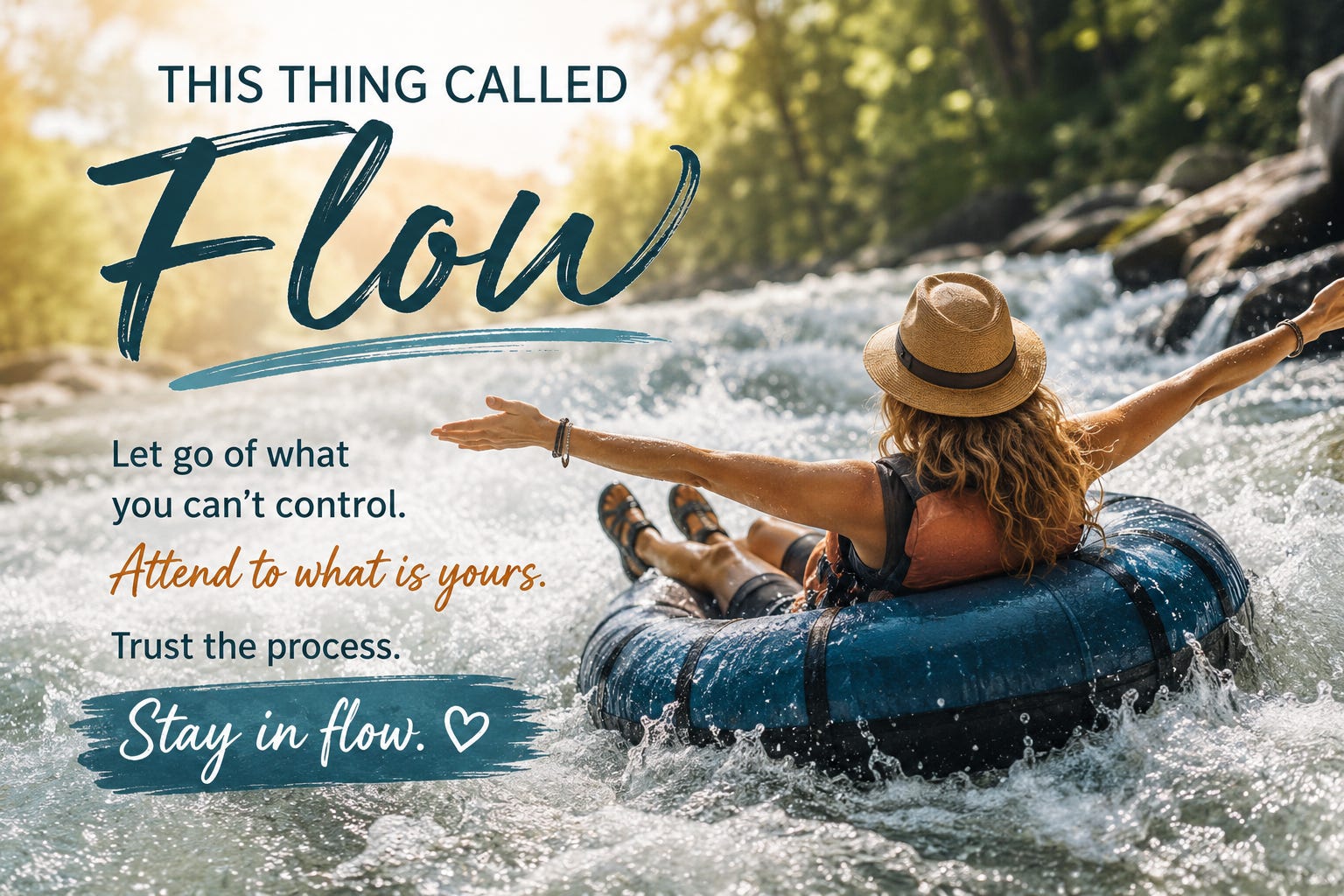
I’ve spent most of my life trying to hold everything together.
Responsible. Capable. Reliable.
But lately I’ve been wondering: what happens when holding everything together is the very thing keeping us out of flow?
So what is this thing called flow, and how do we find it?
Don’t you wish someone could hand you a manual for this mysterious state and explain exactly how to cooperate with it? Maybe flow isn’t something we master so much as something we learn to stop resisting.
In twelve-step groups, you hear a lot about “detaching with love.”
In spiritual communities, you’re told that attachment is the root of suffering.
But does that mean we shouldn’t care? That somehow we should feel less?
For a long time, I thought so. I thought peace required hardening my heart, armoring up, or withdrawing from life to protect myself.
But lately, I’ve been reflecting on the idea of ease. How do we remain in flow instead of fighting against a rapidly changing world?
Time feels like it’s speeding up, and my reflex is to clamp down. I want things to slow so I can feel more in control. (Can you tell I’m not the kind of gal who enjoys roller coasters—or would willingly get on one?)
And then there are the painful things in life: the unresolved situations, the relationships we want to fix, the outcomes we desperately want to change. We convince ourselves we can’t have peace until everything is settled.
But is there flow available even there?
I know resistance isn’t the answer.
You can feel resistance in the body—in the tension, the rumination, the endless mental rehearsals and machinations. It doesn’t feel good.
This is not flow.
So how do I flow more and loosen my need to control things, people, outcomes… even myself and my reactions?
First: I don’t have to understand everything in order to accept it.
If I insist that understanding must come first, I’m going to wrestle constantly with life itself.
More and more, I trust that understanding comes with time. That realization releases something in me. I can let things unfold without forcing immediate answers. I can trust the process.
Second: The Serenity Prayer
I’ve come to deeply appreciate the wisdom in something so often quoted that it’s easy to overlook:
Grant me the serenity to accept the things I cannot change…
Some things are simply not mine to control. I can’t make decisions for other people. I usually can’t change their minds—especially through unsolicited advice, which is often just criticism wearing a helpful disguise.
The sooner I stop trying to manage everyone else, the more energy I have for what actually belongs to me.
That usually means examining my own attitudes, choices, and actions. Staying in my lane. Tending to my own business instead of yours.
And when all else fails, I return to the first truth: I don’t have to understand something in order to accept it. I don’t even have to agree with it.
I do, however, have choice. I have power.
The focus simply shifts to what I can control: my responses, my integrity, my willingness to grow.
Life is generous in that way. It keeps giving me opportunities to become the next version of myself.
And when I attend to what is mine to attend to, life becomes clearer and simpler. I experience more joy. I loosen my grip on the things keeping me stuck.
Honestly, I’m releasing a whole lot of extra jobs I was never meant to carry.
That doesn’t mean these choices are easy.
Often they come after wrestling deeply with myself. Releasing control can uncover grief and fear that have been hiding underneath. Sometimes I realize my need for people to agree with me—or for life to go a certain way—is really about trying to feel safe.
But maybe safety doesn’t come from control.
Can I open myself enough to even consider that possibility?
And then I breathe into the space created by letting go.
Those are the choices that feel supported.
Those are empowered choices.
Third: I allow myself to have reactions—and I leave space around them.
This past week, I walked laps around the parking lot at work just to “get the mad out.” I didn’t want to unload my frustration onto other people. I needed somewhere for the energy to move so I could respond instead of react.
Other times, I journal.
Sometimes I shift my mood by blasting music and singing at the top of my lungs.
And sometimes what I really need is laughter. Laughter can loosen the heaviness and help me get unstuck.
Find what works for you.
The point is this: emotions need to move through us too. They carry wisdom, but they can also cloud judgment when we’re overwhelmed—what I call “the red zone” in my book, Joy and Ease: Are You Ready to Change Your Life?
We are not controlled by everything happening around us. We still get to choose who we want to be.
Emotions are not problems to fix. They are part of being human.
When we learn to sit with our feelings instead of fighting them, we expand our capacity for them. And when we can hold our own feelings without judgement and reactivity, we gain the ability to hold space for others too.
That, I think, is flow.
So these are a few things I’m practicing to live in flow more often.
This morning, after a particularly difficult week, I quietly patted myself on the back. I had navigated some pretty choppy waters. I let go of things that would have drowned me if I’d kept clinging to them. I released what I could not fix, change, or control.
And I attended to what was mine to attend to.
Yup, I thought. Well done!
And tomorrow I’ll practice some more….
Point of Practice
Take a moment and read the Serenity Prayer aloud:
God (Higher Power, Universe), grant me the serenity to accept the things I cannot change,
the courage to change the things I can,
and the wisdom to know the difference.
Now pause and reflect on what’s on your plate right now.
What category does each situation fall into?
Something that needs acceptance?
Or something that requires courage?
As you move forward, what would each response look like in practice?